The Shape of a Journey: What a Route Gives You Besides Arrival
Route quality helps you choose a path for the day ahead, weighing transfers, pauses, and views so the journey feels manageable as well as worthwhile.
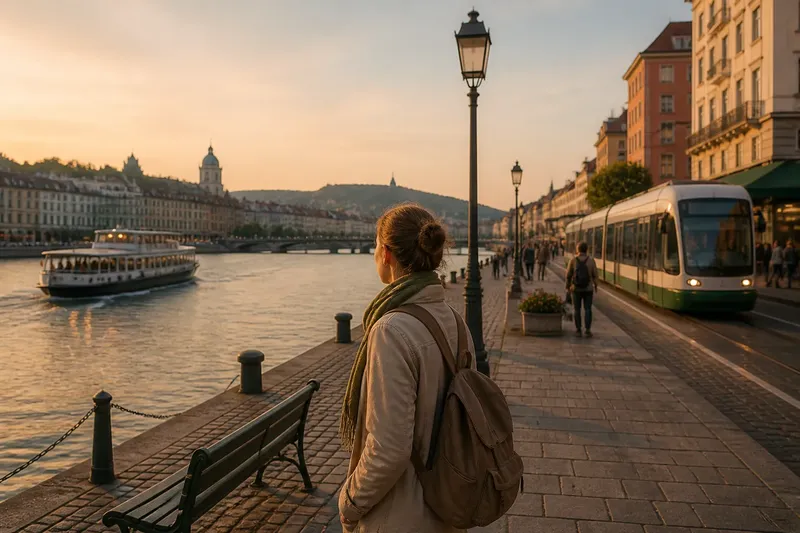
The common route-planning mistake is choosing the line that looks quickest and treating everything else as a bonus. Route quality matters because a string of awkward transfers can leave you tired before the visit begins. Think about what the passage itself gives you, not only where it ends.
Route quality in practice
Route quality is the character of the journey between two places: its pace, transitions, opportunities to pause, and the attention it asks of you. A direct line can be right for a late arrival or a day with little energy. On another day, a slower path may make the trip feel like part of the visit rather than time spent getting through it.
Start with a simple question: what would make this stretch feel worthwhile? You might want a quiet walk after a crowded station, a chance to see a harbor from the water, or a straightforward transfer before a long meal. Compare the actual stops, connections, walking segments, and service times, then choose according to what matters for that stretch.
Transitions set the tone
A route is made of handoffs. You may leave a train, find a bus stop, cross a busy street, and then walk the last stretch with a bag. Each change asks for attention. A route with fewer transfers can feel calmer, even if it takes longer, while a well-timed change can offer a welcome pause.
Look at the transitions on a map and in the surrounding place. Is the station exit near the stop you need? Does the route require crossing a large road or finding a trail entrance? A map may show two lines meeting without showing how awkward the gap feels on foot. Street-level maps, transit diagrams, and local wayfinding signs answer different parts of that question.
Keep an eye on the amount of decision-making, too. A sequence of unfamiliar stops can be tiring when you are carrying luggage or arriving after dark. A simple route may be preferable not because it is faster, but because it leaves your attention free for the destination.
Pace belongs to the place
Different surroundings invite different speeds. A riverside path may reward an unhurried walk; a busy market street may feel better in short stretches with room to step aside. The route need not be scenic at every turn. A shaded bench, a clear crossing, or a quiet block between lively areas can change the texture of the whole passage.
Consider the day’s energy rather than assigning every route the same standard. After a long museum visit, a direct ride back may be kinder than a picturesque detour. On a fresh morning, a route through a neighborhood bakery district might offer a gentle introduction to the city. The useful choice depends on how you expect to feel at that point, not on a rule that scenic always beats direct.
Say you are staying near an invented central station and want to reach an invented waterfront district for dinner. For this example, the tram leaves from the station entrance at 6:10 p.m. and reaches the waterfront stop at 6:30 p.m.; from there, it is a short walk to the restaurant. A river bus leaves at 5:50 p.m., stops at the old quay at 6:15 p.m., and reaches the waterfront landing at 6:35 p.m.; the landing is followed by a longer walk along the quay. If the reservation is at 7:00 p.m. and you want a calm arrival, the tram leaves more time for the final walk and finding the entrance. If the evening itself is the point and you are comfortable with the quay walk, the river bus offers a water-level view, but its earlier departure and longer walk are part of the trade. Check current departure boards before choosing; the example times are invented, not service information.
Views are not the only reward
Routes often promise a landmark view, but a journey can be memorable for smaller details: the change from stone paving to boardwalk, the smell of bread near a station, or the moment a crowded avenue opens into a public square. These details are easier to notice when the route leaves room to look around.
Still, a view can be a poor reason to take a route if reaching it involves a difficult or uncertain connection. Ask what the view asks in return: extra wayfinding, an exposed walk, or a transfer that leaves little room for delay. The answer is not automatically to avoid it. It is to choose with a clear sense of the trade.
It is not worth optimizing every block for scenery. Constantly comparing tiny variations can turn a pleasant walk into a navigation task. Pick a broad direction, note one useful landmark, and let the rest of the route be ordinary.
When should you change routes?
Change a route when its conditions no longer match your needs: a connection is disrupted, a path is closed, or the walking demands feel greater than expected. Before setting out, note one straightforward alternative, such as a nearby transit stop or a direct street back.
Should I choose the scenic route?
Choose it when the scenery is part of what you want from the day and the route’s access suits your energy. If you mainly need a reliable arrival, save the view for another stretch rather than adding a detour by habit.
How can I compare routes beyond travel time?
Compare transfers, walking conditions, wayfinding, places to pause, and how much attention each option demands. A transit map helps with connections, while a street map can reveal crossings and the feel of the last walk.
What if a route becomes tiring?
Pause somewhere public and comfortable, then check whether a simpler continuation is available. A café, station concourse, or staffed visitor center can be a sensible place to reassess without rushing the next decision.
Should I plan every turn?
Plan the parts that could make you uncertain, such as a transfer or an unfamiliar exit. For a straightforward walk, a starting point and one landmark may be enough to keep the journey legible.
Leave room to adapt
A route is a proposal, not a promise that every segment will suit the day. Weather, crowding, a closed path, or a change in your energy can make another option more appealing. Keep one simple alternative in mind, such as a nearby transit stop or a more direct street back.
When a route depends on service details, access rules, or local conditions, check the relevant transit operator, venue, or local guidance before setting out. A brief check can clarify whether a connection is running and whether a path is open, without requiring you to plan every possible variation.
Route quality is not a contest between speed and scenery. It is a fit between the passage and the day you want to have. Before leaving, confirm the next connection and the final approach; that small check can preserve the freedom to pay attention once you are underway.